
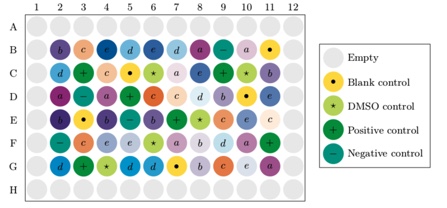
An entry by Maria Andreina Francisco in a thread at the Constraint Google Group engendered several thoughts, which I thought I’d collect into a blog post. Italics are excerpts from Maria’s entry.
I’m currently a postdoc at a pharmaceutical bioinformatics group.
It is always exciting to hear about CP applications to bioinformatics. The last International Workshop on Constraint-Based Methods for Bioinformatics I’m aware of (the 12th, WCB’16) was in 2016. There was one scheduled for 2018, but I’m not sure if it took place, or if there has been one since; does anyone know? Is it time for another? In any case, I’ve added Andreina’s ModRef 2020 contribution on microplate layout design to my nascent page of Sample Applications of CP.
I share Alexander’s experience that building a first proof of concept with minizinc is quick and painless, but getting it to work on larger instances with more complex constraints… well, not so quick and painless.
It appears that there is a research “avenue” opportunity here, which may be difficult to “enter”, but very rewarding if new entrances can be found. Can we conduct some fundamental research addressing the difficulties of practial implementation, especially with regards to “scaling up”?
For example, I once heard an observation from a practioner that a perceived drawback of CP for end users was that seemingly small changes to the model could have unpredictably big effects on solution time. Somehow that seems like a problem that could be amenable to some fundamental research.
Some sort of general comment would be that I think it was easier to write models when I knew less about CP. Nowadays I imagine a model in my head only to realise that all the pieces are not all available in one solver and I need to decide which solver/parts I want to keep and rethink the rest.
The idea that it could be easier to write models when you know less about CP, because all the pieces you want aren’t available in one solver, is an interesting take on things. Could a ’smorgasbord’ approach — as opposed to a ‘portfolio’ approach 🙂 be implemented that allowed one to pick and choose and assemble the pieces one needed, as needed? Or better yet could one automate this, build a system that analyzed the problem and automatically assembled the pieces to build and operate on an appropriate model? Back to my “Holy Grail” hobbyhorse. 🙂
 Gene Freuder