Category Archives: Applications

Puzzles

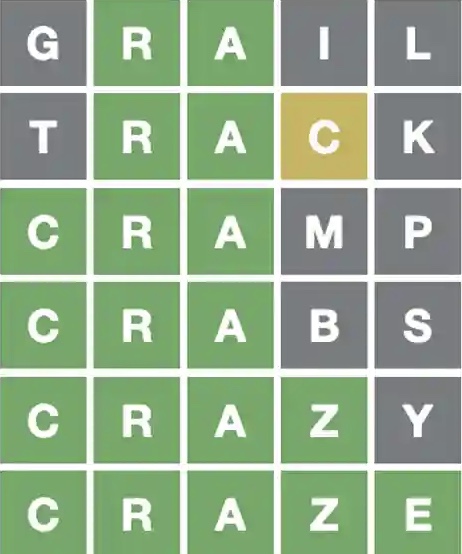
The latest puzzle craze is Wordle. Of course, it is a CSP (constraint satisfaction problem), see here. As was the Sudoku puzzle craze, see here. As are so many puzzles, from crossword puzzles to logic puzzles.

If you think this is all just fun and games, check out this paper on Fast and Flexible Protein Design Using Deep Graph Neural Networks. From the summary:

“Protein structure and function is determined by the arrangement of the linear sequence of amino acids in 3D space. We show that a deep graph neural network, ProteinSolver, can precisely design sequences that fold into a predetermined shape by phrasing this challenge as a constraint satisfaction problem (CSP), akin to Sudoku puzzles.” 

Photo: Josh Wardle (in The Guardian)

Queens

Quanta has an article “Mathematician Answers Chess Problem About Attacking Queens“. I thought at first that the headline was a bit strange as we in Constraint Programming, and others, have been solving the n-Queens problem for many years now: how to place n queen chess pieces on an nxn board such that they don’t attack each other. However, the headline is referring not to the problem of finding solutions per se, but to the question of how many solutions there are for any n, for which there has not been any precise answer (other than finding them all). Michael Simkin of Harvard hasn’t actually found a precise answer either, but he has apparently made good progress on narrowing it down. According to the Quanta article “Simkin proved that for huge chessboards with a large number of queens, there are approximately (0.143n)n configurations”.

This also reminded me that there are ways of constructing solutions for the n-Queens problem without search, e.g. Constructions for the Solution of the m Queens Problem, which I conveniently ignore because the problem of searching for a solution has been so useful for both teaching and research in CP. More generally, one can go down quite a rabbit hole with the n-Queens problem, not surprising for a problem that was first published, as the 8-Queens problem, in 1848, and studied by Gauss. There is an n-Queens bibliography online with 336 entries.

Abstracting methods developed for a specific application is, of course, a good “meta-heuristic” for seeking new, more general methods for Constraint Programming. For well-studied problems like n-Queens or graph coloring, I suspect that there is a good deal that is still lurking in the older literature, or appearing in new publications, that could be mined to advance CP.

Doing Good

The Operations Research organizations INFORMS and IFORS have initiatives for using technology for good that CP people might want to contribute to:

INFORMS Pro Bono Analytics (PBA) brings together INFORMS members, other analytics practitioners, and nonprofit professionals and organizations working in underserved communities with the goal of enabling these vital nonprofits to begin making data driven decisions. In short, think “helping nonprofits with data” when you think of PBA. Sometimes our work is as complex as building a system to forecast real-time demand for services, and other times it’s as simple as helping an organization choose between analytical tools or organize and store collected data from past fundraising campaigns. Even if your organization is just getting started with data, we can provide advice and assistance on what data to collect, how to collect it, and where to keep it.

The aim of the [IFORS] Developing Countries On-Line Resources page is to offer the OR worker all publicly-available materials on the topic of Operations Research for Development. It also aims to provide a venue for people who are working in the area to share their completed or in-process work, learn from others, and stimulate comments and discussions on the work.

These could be of particular interest to those who participate in the CPAIOR conferences.

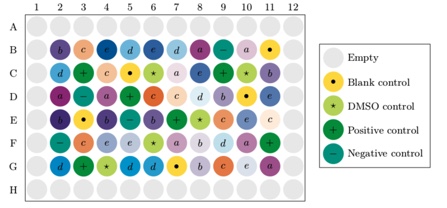
Microplates, Avenues and Smorgasbords

An entry by Maria Andreina Francisco in a thread at the Constraint Google Group engendered several thoughts, which I thought I’d collect into a blog post. Italics are excerpts from Maria’s entry. 

I’m currently a postdoc at a pharmaceutical bioinformatics group.  

It is always exciting to hear about CP applications to bioinformatics. The last International Workshop on Constraint-Based Methods for Bioinformatics I’m aware of (the 12th, WCB’16) was in 2016. There was one scheduled for 2018, but I’m not sure if it took place, or if there has been one since; does anyone know? Is it time for another? In any case, I’ve added Andreina’s ModRef 2020 contribution on microplate layout design to my nascent page of Sample Applications of CP

I share Alexander’s experience that building a first proof of concept with minizinc is quick and painless, but getting it to work on larger instances with more complex constraints… well, not so quick and painless. 

It appears that there is a research “avenue” opportunity here, which may be difficult to “enter”, but very rewarding if new entrances can be found. Can we conduct some fundamental research addressing the difficulties of practial implementation, especially with regards to “scaling up”? 

For example, I once heard an observation from a practioner that a perceived drawback of CP for end users was that seemingly small changes to the model could have unpredictably big effects on solution time. Somehow that seems like a problem that could be amenable to some fundamental research. 

Some sort of general comment would be that I think it was easier to write models when I knew less about CP.  Nowadays I imagine a model in my head only to realise that all the pieces are not all available in one solver and I need to decide which solver/parts I want to keep and rethink the rest. 

The idea that it could be easier to write models when you know less about CP, because all the pieces you want aren’t available in one solver, is an interesting take on things. Could a ’smorgasbord’ approach — as opposed to a ‘portfolio’ approach 🙂 be implemented that allowed one to pick and choose and assemble the pieces one needed, as needed? Or better yet could one automate this, build a system that analyzed the problem and automatically assembled the pieces to build and operate on an appropriate model? Back to my “Holy Grail” hobbyhorse. 🙂

Erdős-Faber-Lovász

Mathematicians have recently “proven” the Erdős-Faber-Lovász coloring conjecture. I put “proven” in quotes because the proof only works for “large enough” hypergraphs, a restriction that I think is rather cavalierly addressed in the linked article. Nevertheless, it would be interesting to consider whether some of the techniques used in the proof could be adapted for general constraint satisfaction problem solving. At least one technique they use seems already to be related to a CP staple: “hardest first (fail first)” ordering; perhaps some readers can identify others. Even more interesting would be if some of the methods used in the proof suggest new CP techniques. And it would be exciting if any existing CP techniques suggest alternative or improved proofs of the conjecture.

What’s in a Name

Back in 2004 the Boston Globe newspaper ran a story about “the most influential academic discipline you’ve never heard of”. What was the discipline? Operations research.

Operation everything

It stocks your grocery store, schedules your favorite team’s games, and helps plan your vacation. A primer on the most influential academic discipline you’ve never heard of.

This is rather ironic for those of us in Constraint Programming, since CP deals with many of the same applications as Operations Research, and is, if anything, less well known.

Part of the problem unquestionably lies in the name. “Operations Research”, what is that? The study of hospitals? And the alternative, “Mathematical Programming”, is even worse. Is it mathematics? Is it coding? The only worse name for a field? “Constraint Programming”.

I once had a fellow from a company that I was trying to interest in working with my lab tell me he liked the idea, but ask me if there was some other name for what I did, because “constraints” had such a negative connotation, it turned other people in his company off. Of course, we do have some very positive terms associated with the field: “satisfaction”, “relaxation”, “optimization”. But if I said “I use relaxation for optimal satisfaction”, people might think I was some kind of new age guru.

Indeed even “optimization” is an imperfect standard bearer. I once had a fellow at a commercially-oriented conference tell me that “optimization” could turn his potential customers off. Astonished, I asked why, and he explained that they worried that it meant that the computer would make all the decisions and they would be cut out of the loop. Of course, it doesn’t have to mean that, but perhaps such fears help to explain the current popularity of terms like “human-centred” and “human-aware” as modifiers to “Artificial Intelligence”.

In any case, if we are to compete with such media-friendly terms as “artificial intelligence” and “deep learning” we need to work at getting the message out about what we can do. Actually Operations Research is currently doing a pretty good job of that for their field. See “O.R. & Analytics Impact Everything” at the INFORMS website, and the INFORMS Success Stories.

The ACP has its Success Stories as well, of course, and there are other resources, but we can always do more. I’ve started work on a new page, Sample Applications of Constraint Satisfaction, to make a small contribution towards “getting the word out”.

Refrigerators

I had so much fun with The Application Game that I decided to play again googling “constraint satisfaction problem” and “refrigerator”. I came up with “Service robot planning via solving constraint satisfaction problem“.

The problem of demographic shifts towards the elderly is deteriorating, as the relative number of caregivers is insufficient to provide the support required for their wellbeing, which is further aggravated by the increasingly hectic lifestyle. Service robot is getting more prominent as a possible solution. Robot manipulation and mobility is an important field, but they also require high level planning for these minute actions in order to provide ample support. Automatic service composition, contributed significantly by web services, offers the necessary technology for the task. Robot planning problem can be solved by representing it as constraint satisfaction problem (CSP) due to it being able to support loose binding of services and variables of wider domain. 

What does this have to do with refrigerators?

Given a certain goal, planner module will compose a sequence of plans for the robot to execute such that after the plans are completed, the goal is achieved. For example, given that the goal is to place a canned soft drink in the fridge and that all cabinet needs to be closed, the robot will first find where the soft drink is. If there is one that happens to be in the kitchen cabinet, the robot will approach it, open the cabinet and pick up the soft drink, and then close it. It will subsequently approach and open the fridge, after which it will place the canned drink before closing it. No prior programming is required for the plan.

Ok, tenuous, but this paper illustrates an interesting point.

The paper is published in the ROBOMECH Journal. Its authors are in a Graduate School of System Design, not a computer science department. The closest it comes to referencing the CP literature seems to be a 2008 paper by De Moura and BjØrner on Z3: An efficient SMT solver, in the International Conference on Tools and Algorithms for the Construction and Analysis of Systems and a 2014 paper by Georgievski and Aiello, “An Overview of Hierarchical Task Network Planning” in ArXiv.

In other words, your typical attendee at the CP conference or reader of the Constraints journal might well not have run across this paper. I believe there are many such papers. In a way, this is a positive sign, of the degree to which our “baby” has moved out into the world. Still, the more we are aware of applications of constraint satisfaction the better. The more that people applying constraint satisfaction are aware of the broader body of work in our field the better. The more that people in general are aware of the breadth of applications of constraint satisfaction the better. An application like this one to service robots could help interest students in the field or convince funding agencies of our “impact”. It could suggest new collaboration opportunities or suggest new directions for basic research.

The Application Game

Constraint programming has an amazing variety of applications. To illustrate this, I’ve come up with “The Application Game”. It is a very simple game: you type “constraint satisfaction problem” and some other random topic into Google search and see if you come up with an application of constraint satisfaction to that topic.

I first tried “bananas”. Unfortunately “bananas” returns too many references to the classic “monkey and bananas” problem. I assumed many of those did not actually apply constraint satisfaction to that problem, and even if they did, I was looking for a “real world” application.

Nevertheless the resulting hits provided some interesting diversions. I encountered this piece in Stanford’s “digital stacks” by Rodney Brooks (long before Roomba presumably) about Fikes’ REF-ARF. REF-ARF plays an interesting role in the history of constraint saatisfaction. It provides an example of constraint satisfaction in the very first issue of the Artificial Intelligence journal. In his piece on REF-ARF, Brooks says that the type of problem of which the monkey and bananas problem is an example “cannot be stated as a boolean constraint satisfaction problem because the length of the sequence of operators q is not specified”, in other words because the length of the plan required to solve it is not given, so REF-ARF’s heuristic search component must be used instead. Of course, later this “constraint” in applying constraint satisfaction to planning was overcome by simply using successively longer planning horizons. This is an example of the type of approach (see “iterative deepening“) that is easily dismissed as impractically wasteful, but can turn out to be worth investigating.

And then there was this: BANANAS: Automated design and autonomous control of hybrid solver cooperations.

However, I eventually gave up on “bananas” and tried googling for something more timely: “constraint satisfaction problem” and “COVID”. I quickly found Validating Optimal COVID-19 Vaccine Distribution Models.

I’m sure there are other COVID-related applications; I know of at least one. I didn’t conduct an exhaustive search, but I couldn’t resist looking at a just few more Google hits, and almost immediately turned up this: Constraint-Checking Editor for Procedure Tracking (ConCEPT). Now this is from 2013 and so, of course, has nothing to do with COVID. It is related instead to operational procedures for manned space operations! This is cool, though not totally unexpected: I myself once did some work with NASA. The principal investigator on the ConCEPT project was Mark Boddy, whom some of you may know: for example, Mark was co-chair of ICAPS 2007. Mark is co-owner and Chief Scientist at Adventium Labs. Here is a paper on ConCEPT from the Workshop on AI in Space at the 2015 International Joint Conferences on Artificial Intelligence. I find particularly interesting its relationship to maintenance, which I think is an understudied area. I did some work a while ago on Maintaining constraint-based applications with Tomas Nordlander and Rick Wallace.

So, isn’t The Application Game fun? 🙂 Try it yourself, and I encourage you to report your experiences in the Comments.

Impact

I recently connected, via Linkedin, with the Director of Constraint Programming Research and DevelopmentI at Oracle. He told me that the Dynamic CSP features of Oracle’s Solver are based on concepts presented in some papers I wrote years ago with a student, Dan Sabin. I promptly passed that info on to Dan.

I believe this sort of “knowledge transfer” or “impact” often “flys under the radar”. Aside from patent or paper citations there is no formal mechanism for acknowledging such influence. I would encourage folks in industry to take a moment now and then to send a note to academics, or speak with them at a conference, and let them know that their work has been helpful. This is gratifying and useful for academics, and, who knows, might encourage further productive interaction.