Announcing a Constraint Acquisition Challenge in connection with the Fifth Workshop on Progress Towards the Holy Grail. Further information is available here.
Please consider participating!


Announcing a Constraint Acquisition Challenge in connection with the Fifth Workshop on Progress Towards the Holy Grail. Further information is available here.
Please consider participating!
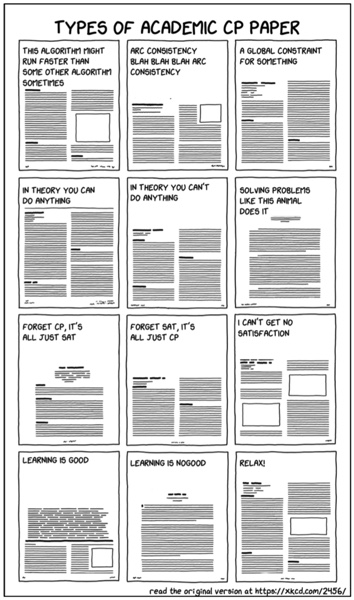
The estimable XKCD has produced a parody taxonomy of academic papers that has attracted interest and imitation. An enterprising fellow has produced a tool for constructing one’s own variation. I present mine here, in a comic, not a critical, spirit.

With the increasing presence and popularity of AI it is important to get the word out that constraint satisfaction is AI. While a strength of the field is its multi-disciplinary nature, it certainly has a ‘home’ — arguably its ‘primary residence’ 🙂 in the AI community. In fact, I’ve argued that constraints are ubiquitous in AI, to the point where they might even serve as a kind of “lingua franca” unifying the subfields of AI. In particular, constraint satisfaction has been used for machine learning and vice versa, and constraints resonate with other currently high profile topics in AI like explanation and human-centric AI.
Members of the constraints community have a very strong presence in the larger AI community. For example, Francesca Rossi, a former president of the ACP, is a past president of IJCAI and future president of AAAI, and Barry O’Sullivan, a former president of the ACP, is a past president of EurAI and a current member of the Executive Council of AAAI.

I’ve connected my blog to LinkedIn so I can easily send some of my posts there. I’m not ‘fluent’ in LinkedIn, so this is just a post to see how the connection works. (Readers can also sign up to follow my blog directly via RSS or email.)
I noticed this week that views of my post on Comparing CP and MIP had gone up 4,940.00%! Of course, that is a bit of a joke, because the prior view count was so tiny. Nevertheless, I was curious as to what caused this sudden attention to an older post. There were also two Comments, which in addition to being helpful additions to the post, provided a clue as to its sudden popularity. One Comment was from Philippe Laborie and the other from Eray Cakici. A little googling revealed that a link to my post had appeared in their Twitter accounts. Philippe tweeted and Eray retweeted.
So let me return the favor by pointing you at the SlideShare presentations of Philippe and Eray. And “keep those cards and letters coming” everyone. An old expression, perhaps I should say nowadays “keep those comments and tweets coming”. 🙂
Helmut Simonis just sent me a new collection of his photos from the CP 2011 conference in Perugia. Great photos and great memories. As it happens Marius Silaghi and Christian Bessiere described CP 2011 in their article Crossroads in Constraint Programming for the IEEE Intelligent Informatics Bulletin. For those of you who were there, can you spot yourself in the photo below?

How sad that CP 2021 scheduled for beautiful Montpellier, will apparently take place online, due to COVID-19.
Looking for items to populate my new constraints resources site, I delved into the MIT CSAIL video archive for some footage I knew was there showcasing the early work of Dave Waltz on scene labeling, which used his seminal arc consistency algorithm. Check out this video; the scene labeling starts around the 7:15 mark.
If you’re wondering why it is “eye of a robot” and not “eyes”, our “robot” at the time was a Cyclops. There was one huge camera, and another, separate, enormous arm. The story goes that the arm came loose from its moorings one day and backed Gerry Sussman into a corner. The eye and hand together were used for the pioneering MIT Copy Demo project.
I shared an office in the old MIT AI Lab for a while with Dave Waltz. He describes some of that time here. If you like reading about “history”, there is more historical material in Constraint Satisfaction: An Emerging Paradigm from the Handbook of Constraint Programming, in “The Complexity of Constraint Satisfaction Revisited“, in a series of articles on Papers with Impact, and in the “commentaries” contained in a “virtual volume” celebrating the first 25 years of the CP conference.
Perhaps readers can share historical anecdotes in the comments.
Among the types of posts you may find in this Blog:
Note that I may edit posts — including this one 🙂 after their original posting.
Comments are encouraged. Use “Leave a Reply”.
Note that you can subscribe to the blog via RSS or follow via email. See the sidebar.
Ok, having just written a blog post on stats and visualization, I’m going recursive here, and posting a Cirrus word cloud visualization of my blog page (prior to this post):
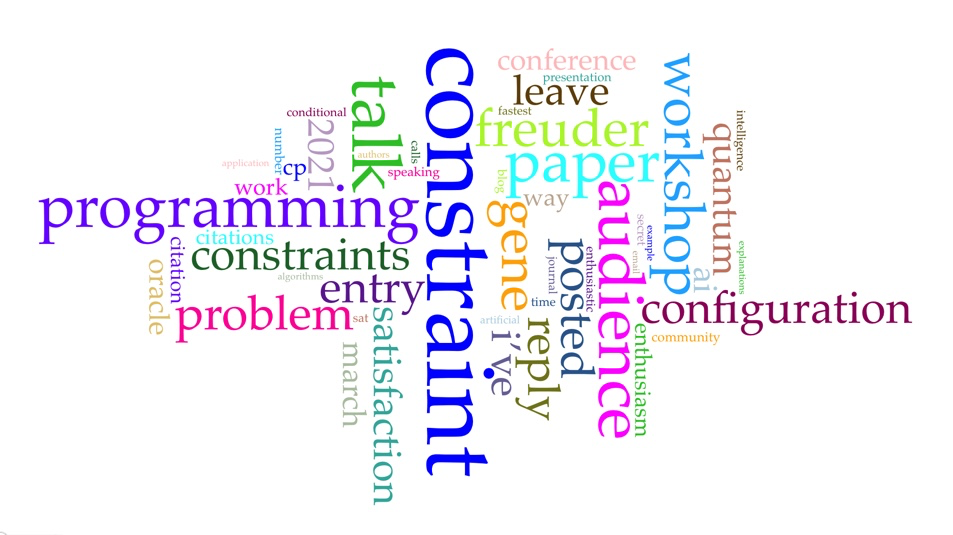
I did this with Voyant Tools, which provide all kinds of textual analysis. For example, when I feed it the CP2021 URL it tells me that “Montpellier” has a .6666667 correlation with “October” with a significance of 0.035265204. Well, perhaps not the best example. 🙂 Let’s go back to word clouds again with the list of accepted papers for CP 2020:
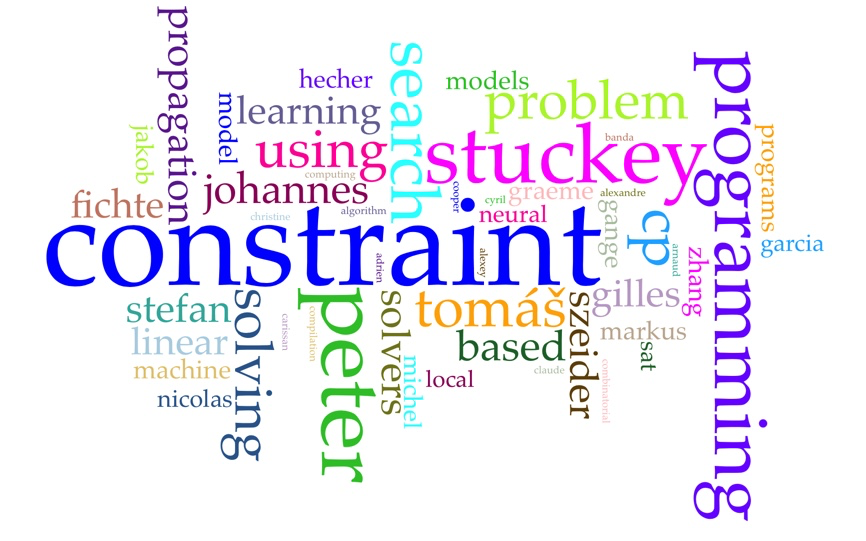
(which, for a small fee, I can make available to Professor Stuckey, suitable for framing).
Compare with a word cloud for the accepted papers at CP 2010:
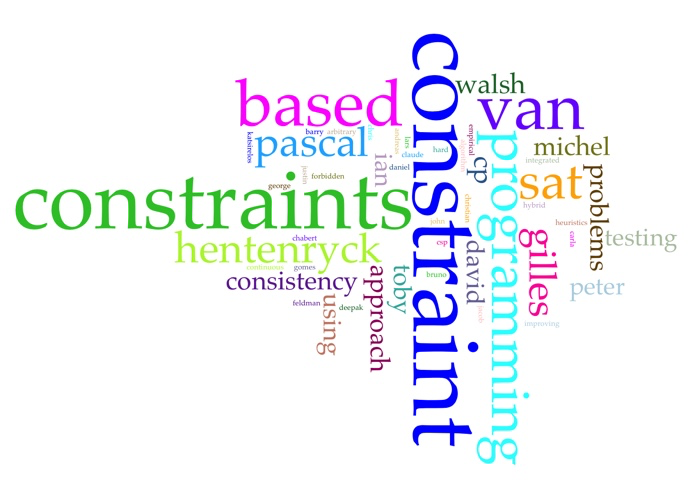
“Learning” doesn’t appear in 2010, but is fairly prominent in 2020. (It may have helped that the call for papers included a thematic track on “CP, Data science and Machine Learning”.) I think there are some other interesting differences, but I’ll leave that as an exercise for the reader — you can post answers in the comments (“reply”). Of course, these word clouds are only snapshots; it would be interesting to visualize trending terms over the full span of the conference. Are there any potential Hans Roslings among us?
I’ve been playing with Microsoft Academic Entity Analytics. It provides an interesting variety of statistics and views. I looked up “constraint satisfaction problem“. Turns out the “top author” is Berk Hess. If that surprises you, you’ll be even more surprised to learn that Professor Hess achieved this distinction with only three “constraint satisfaction problem” papers. Understanding dawns when we see that the top-cited of the three, with 13,445 citations, is:
GROMACS 4: Algorithms for highly efficient, load-balanced, and scalable molecular simulation
2008 JOURNAL OF CHEMICAL THEORY AND COMPUTATION
Berk Hess, Carsten Kutzner, David van der Spoel, Erik Lindahl
In fact, Hess, Kutzner, van der Spoel and Lindahl are the top four authors listed for “constraint satisfaction problem”. I doubt that the Constraint Programming community has anything to offer here, but it might be worth checking out; could do wonders for your citation count.
So some caution needs to be exercised in viewing these stats, but they are still interesting. Another thing that stood out to me: the total number of “constraint satisfaction problem” publications reached its peak in 2013 with 478, and has declined to 256 in 2020. On the other hand, the number of “constraint optimization problem” publications went from 18 in 2013 to 34 in 2020. And in case you were wondering, the top five authors for “constraint optimization problem” are the authors of this paper (which has 337 citations and actually uses Integer Linear Programming):
Collective Generation of Natural Image Descriptions
2012 MEETING OF THE ASSOCIATION FOR COMPUTATIONAL LINGUISTICS
Polina Kuznetsova, Vicente Ordonez, Alexander Berg, Tamara Berg, Yejin Choi
There are many other ways to play with Microsoft Academic’s stats and graphs. An example. Another example.
Or perhaps you want to use the Microsoft Academic Graph software to create a bespoke tool for the constraints community? An example of the kind of thing that can be done.
And there are many other tools that might be used to produce many types of statistics or visualizations for the constraints community. Perhaps you have additional suggestions — for tools to use or statistics/visualizations that you’d like to see?
 Gene Freuder